
On Misreading the Classics
Swift's Parody of Modern Learnedness in Gulliver's Travels

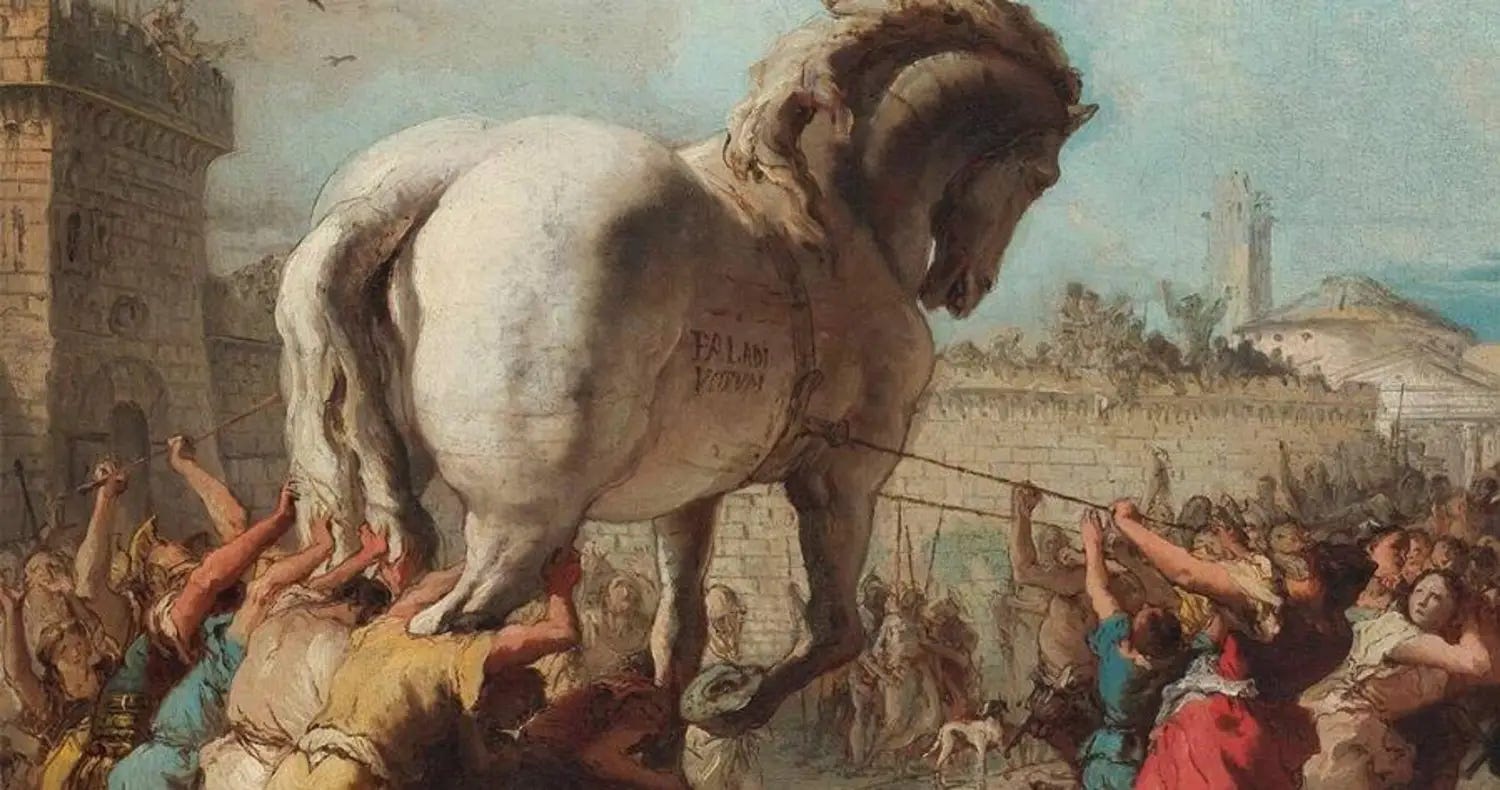
Lemuel Gulliver, a rather ordinary man, never intended to become the Sinon of the Age of Enlightenment, a liar who skillfully maneuvered a Trojan horse of ancient philosophy into the court of modernity. Jonathan Swift, however, aimed at nothing less.
The questionable nature of Jonathan Swift’s project looms large in many of Gulliver’s words and deeds, but one particularly strange place in Gulliver’s Travels that prompts it to surface is a quotation Gulliver offers after stating that due to the influence of his “noble masters” the Houyhnhnms, he can never speak or write falsely: “Nec si miserum Fortuna Sinonem finxit, vanum etiam, mendacemque improba finget.”. “Though Fortune has made Sinon wretched, she has not made him untrue and a liar.”1 The quotation might not strike the reader as particularly off key until it is recognized that Gulliver appears to have made a laughable error. He is quoting Virgil’s Aeneid, and the man speaking is Sinon himself, a Greek who treacherously convinces the Trojans to accept a gift horse during the war at Illium. In fact, Gulliver quotes his words from this very speech. If Gulliver had not been claiming to have just returned from a land of talking horses and did not hope to improve the morals of Europe and perhaps even mankind through the influence of a piece of writing which he insists is utterly truthful, perhaps the quotation would not seem quite so weighty. Has Gulliver made an honest error, or does he admire Sinon? In the first case, Gulliver begins to seem like a bit of a fool who has become arguably untethered in his reason by the end of his last journey; in the second, Gulliver is throwing his lot in with those who do not tell the truth, which should change the reader’s perception of who Gulliver is and what he aims to achieve. In either case the underlying intention in Swift’s portrayal of his protagonist begs to be addressed, and Swift’s relationship to the ancient authors clarified.
At the the beginning of the last chapter of the book, Gulliver states what he believes constitutes the goal of all travel writing: “...a traveller’s chief aim should be to make men wiser and better, and to improve their minds by the bad, as well as the good example of what they deliver concerning foreign places.” (Swift 255) Gulliver accepts the urging of his friends and chooses to publish his journals, aiming thereby to improve the Europeans and particularly the English, while ultimately striving to reform mankind itself. After giving this project six months, he realizes the absurdity of such an attempt and abandons all such endeavors forever. Gulliver’s attempts at reformation are highly suspect: he claims that more than anything he hates pride, yet he himself is painfully proud and disdainful. He condemns sexual misconduct, yet his own erotic passions are dubious. Above all else he claims he is committed to truth, but there are several places where his veracity must be called into question. Why is this man who is ultimately so morally unreliable chosen as the vehicle for Swift’s project of moral inculcation?
It seems clear that there are two projects attempted by the two ‘authors’ and the projects not identical. While Gulliver is enchanted by the dream of reason and grows to hate humanity and wish it nothing but ill, Swift intends to point out the absurdity not only of the modern scientific project which consists of placing the power of reason at the whim of the passions, but also the folly of attempting to instead organize the life of human beings entirely according to reason, since human beings are not completely defined by the traditional title of “rational animal,” a title derived from a mistranslation of Aristotle’s “ζώον λόγον έχον (zoon logon echon),” or “the living thing possessing speech.”
The place to begin is Brobdingnag, where certain sentiments towards the ancients begin to appear in Gulliver that may have previously existed (it is known that he is a reader “of the best authors, ancient and modern”) or began to arise during the second journey. When the learned men of Brobdingnag examine him to determine what he is, he makes an ironic dig at the intellectuals of his own country: “After much debate, they concluded unanimously that I was only Relplum Scalcath, which is interpreted literally Lusus Naturae (a freak of nature), a determination exactly agreeable to the modern philosophy of Europe: whose professors, disdaining the old evasion of occult causes, whereby the followers of Aristotle endeavor in vain to disguise their ignorance; have invented this wonderful solution of all difficulties, to the unspeakable advancement of human knowledge.”(82) This ironic barb is pointed directly at the Baconian moderns, and its implicit endorsement of Aristotle and even possibly the Scholastics is evident.
These sentiments about the ancients begin to take clearer shape in Gulliver’s conversation with the king about the politics of Europe. Before embarking on this discussion, he makes another telling reference to the ancients, once again Greek, although this time a Greek living under the Romans, Dionysius Halicarnassensis. This author praises the Romans in order to convince the Greeks to submit to their authority, and certainly did not maintain the “laudable partiality” to his “political mother” which Gulliver claims he “with so much justice recommends to an historian.” (109) Here again, the tension between Gulliver and Swift is evident, and the question arises— who is being ironic? It seems that Gulliver is once again misreading a classic author, but in any case, the irony continues, when Gulliver says: “The want of knowledge will ever produce many prejudices and certain narrowness of thinking; from which we and the politer countries of Europe are wholly exempted.” Interestingly, this closed mindedness —particularly to gunpowder— exhibited by the Brobdingnagians Gulliver attributes to not having made a science of politics; an exceptionally modern fascination. Of course, Gulliver seems so eager to show his worth by boasting about Europe that he is unable to praise the Brobdingnagian approach to politics and society which will ultimately come to perhaps be seen as close to Swift’s ideal.
It is essential to remember that Gulliver is not Swift, and we must turn for a moment to another Latin quotation in the work. Facing the title page of the book there is an engraving of Captain Lemuel Gulliver, an average, somewhat handsome man, but with a wisp of a sly grin. Beneath his title lies his remarkable Latin epigram: “Splendide Mendax. Hor.” In English, it reads, “Gloriously False,” and is from the poet Horace. This gloriously false writer has himself attached a Latin quotation on the facing page, which he presumably means to have serve as the motto of the book: Retroq; vulgus abhorret ab his. This one is from Lucretius; the famous line from Book IV in which the “wormwood” of his materialist philosophy is rejected as too bitter: “The people shrink back from it.” Ironically, Gulliver is no materialist, as he shrinks back from the body and the sheer physicality of the world, seeking refuge in the purer realm of moral virtue. Further, his project consists of the attempt to promote this high-browed morality and his use of the quotation seems to try to defend his claim that he alone can face the fact that men are Yahoos, while the common herd “shrinks back” from this terrible truth. Swift on the other hand has warned his readers that Gulliver is not to be trusted.
The problem may be further highlighted by how Gulliver is viewed in Brobdingnag; he seeks to be taken seriously as a rational being but his points literally hold no weight because he is physically insignificant. Instead of being listened to he is merely laughed at and thus forced to reckon with the power of physicality. The bodily nature of human beings is emphasized by Gulliver’s frequent, bizarre eroticized encounters with the gigantic women of Brobdingnag. Gulliver insists that the sheer physicality of their bodies, the overpowering scents and textures disgust him, but his relationship to the erotic is unclear. The question of sexual morality is central in Gulliver’s Travels, and bound to it is the issue of honesty. Gulliver claims vehemently that he never committed the crime of adultery with the wife of the treasurer of Lilliput — the accusation of which helped contribute to his political downfall on the island— but can a reader really believe him? The second voyage reveals the complete lack of restraint among the women of Brobdingnag in engaging in erotic activities with him— why are we to believe that Gulliver acts any more virtuously than they? (So much for its frequent classification as a children’s book— how it ever attained such a status remains an unsettling mystery). Swift hints through these incidents that Gulliver has surreptitiously edited his journals before publication; polishing his own morality so that it might shine more brightly. Gulliver’s veracity has become quite suspect.
In Laputa and Balnibarbi Gulliver seems remarkably grounded in common sense, and it is arguable that here and in most of book three the viewpoints of Swift and Gulliver coincide. Laputa offers a clear parody of a group of intellectuals obsessed with mathematics, abstract science, and musical theory. Fundamentally the focus seems to be on two things: the absurdity of the inhabitants’ concerns —they are terribly melancholy about the prospect of the earth being swallowed by the sun millions of years hence while their practical incompetence is everywhere evident— and second, the effect of their preoccupations upon their morality, particularly their sexual morality. The descriptions of adultery are probably the most vivid illustration of this:
The women of the island have abundance of vivacity; they contemn their husbands, and are exceedingly fond of strangers… The vexation is that they act with too much ease and security; for the husband is always so wrapt in speculation, that the mistress and lover may proceed to the greatest familiarities before his face… (Swift 138)
The message seems clear: morality has suffered under the distractions of science, and common sense cannot help but protest in disgust.
In neighboring Balnibarbi, some people under the influence of the Laputans, “began to dislike the management of everything below; and fell into schemes of putting all arts, sciences, languages, and mechanics upon a new foot.” (150) Here too, the work engaged in is most absurd, but more directed at practical ends, such as extracting sunlight from cucumbers. However, it becomes clear that agriculture has greatly declined since the influence of the Laputans, and even the cleanliness of the people has deteriorated. Here, just as much as in Laputa, the modern scientific project is under attack. Swift suggests that the moderns have wildly misinterpreted the way of life instigated by the ancients: philosophy. Here is reason run amuck, guided by desire, rather than ordering the passions and guiding them correctly. The scientific project is, for Swift, a misguided attempt to escape the natural order of things and live in the clouds, like Socrates in Aristophanes’ parody of philosophy.
The final blow to the modern project from Gulliver’s perspective is the trip to Glubbdubdrib, where he encounters sorcerers who claim they can summon the dead. Here he “meets” Homer, Aristotle, Caesar, and other illustrious personages, both ancient and modern. Gulliver is, more than usual, remarkably gullible, and he believes sincerely that he is conversing with the great souls of the past. He learns from the heroes of Rome about the true extent of their virtues, which surpasses even the classic accounts from Plutarch and Livy. It is important to note that Gulliver claims he merely sees their virtue in their faces and bearing, with nothing else to confirm it except the accounts given by the apparitions. It is still a question whether he has actually learned anything new. In addition the question of what exactly is occurring in this necromancy is never answered; it is quite possible that a person will only see what they want to believe about the dead, since they may be merely mirages. In that case, Gulliver has been primed through his voyages and reading to see virtue in the ancients. After having Aristotle come forth to defend his views successfully against Descartes as well as to predict the fall of the modern systems of nature —this episode might be seen as the pinnacle of the voyage to Glubbdubdrib— he turns his focus to the kings of Europe, whom he ends up despising for their moral weakness and decay which increases from generation to generation. Again, sexual morality and its effects on politics is central for Gulliver: “Here I discovered the true causes of many great events that have surprised the world: how a whore can govern the back-stairs, the back-stairs a council, and the council a senate.” (Swift 171) Now Gulliver is completely ready to be taken in by the humorous idea of a utopia of rational animals and to see it as deadly serious.
Too much reason can make us mad. At last, in Houyhnhnmland, Gulliver succumbs to the belief that the Yahoos are us, and we are Yahoos. For three voyages his misanthropy has been increased by an attempt to bolster himself up by a process whereby he at first boasts about the Europeans, and then later attempts to improve the appearance of his own moral virtue in the eyes of the Houyhnhnms by extraordinarily distorting and undervaluing his own species. In Brobdingnag he attempted the former strategy, and finding himself gaining not in the least, he changes tack for the rest of the book. As a result, his increasingly wretched picture of man leads to a desire to detach from it as far as possible, and Gulliver begins to lose his humanity. Among the Houyhnhnms Gulliver begins to vent extreme misanthropic views. These views begin to take on the same satiric feeling of being blown out of proportion as the wild mockeries of the scientific revolution as portrayed in book three. Gulliver begins to believe deeply that man is a mere Yahoo. These creatures are not human, but through the course of the three books leading up to Houyhnhnm land, Gulliver has become more and more escapist, and after the madness of Laputa and Balnibarbi the reader expects a place of other possibilities. The Yahoos are not human beings, but neither is man a rational animal. Swift points out through the contrast of the Yahoos and the Houyhnhnms that although human beings are not beasts, they are more animal than divine.
It should not be forgotten that Gulliver’s Travels is Swift’s satire on the four facets of man; the physical, the political, the intellectual, and the moral. These four facets complete the picture of what it means to be human and all of the absurdity that that entails. Somehow, these four must be seen clearly, each in their own right, and also in their immense reliance on the first. Gulliver completely fails to do this. Instead, he is tormented by the image of man as animal, maddened by the pursuit of reason and morality, and finally loses all sight of human goodness. Once he leaves the island, he is rescued by a exceedingly kind Portuguese captain named Don Pedro. The most Gulliver can do in response to the remarkable humanity of this captain is “descend to treat him like an animal which had some little portion of reason.” (Swift 251) Gulliver has become so obsessed with reason and so hateful of human beings which he cannot see as anything other than animals that he is blind to the fact that he himself has lost his reason. By the time he returns home, he is unable to bear even being in the same room with his wife and children —“the sight of them only filled me with hatred”— and complains of their smell. His proud tone also smells, and it should alert the reader to the possibility that there has been a deception.
The mistake comes when the reader, coaxed by the neat symmetry of Lilliput and Brobdingnag, expects a foil to Laputa in Book Four. Instead, one is greeted with another extreme, a world in which reason is used as docile animals would use it. This is not the world of the ancients, and, although this is unstated, it seems that Gulliver mistakenly identifies it as being the fulfillment of that expectation. The reader is further enmeshed in Swift’s cunning by the completion of the separation of man’s intellectual and physical aspects, which has been developing since the very beginning of the book. It is clear that man is not the rational animal presented by the Houyhnhnms, but the idea that he is a Yahoo is almost unbearable, and as a response the reader clings to Gulliver as a kind of middle ground. The final trap lies in the choice of horse as an example of a rational animal. Why should Swift choose a horse, of all creatures? In the Phaedrus, and elsewhere in ancient literature, the horse is used as the image of the passions par excellence. These horses have none, which makes them utterly non-human, but it is difficult to see this immediately because of the expectation developed by tradition.
From his conversation with his master Houyhnhnm, Gulliver reports that the horse “agreed entirely with the sentiments of Socrates, as Plato delivers them; which I mention as the highest honour I can do that prince of philosophers…” He adds that “Friendship and benevolence are the two principal virtues among the Houyhnhnms; and these not confined to particular objects but universal to the whole race.” (Swift 234) These sentiments do not, however, transfer to Gulliver. It appears that he has not formed any close friendships with anyone, and by the time he returns home for the last time, he has pushed away even his family. During the course of the book he has a master, a servant, a caretaker, a series of what might tentatively be called sexual partners, and a crew, much of which mutinies, but no one who might be called a friend in the full sense. He has what Aristotle referred to as friendships of utility and pleasure, but even among the Houyhnhnms he has no friendships consisting of goodwill and based on mutual love of the good. As for the Houyhnhnms, the emotion of love which should guide a friendship is beyond their capacity to feel. One is tempted to ask, what good is reason without love and friendship?
The Houyhnhnms are also unable to lie, or so they claim. They are so certain that they are the “perfection of nature” that they cannot see the darker truths about themselves. They cannot say the thing that is not, but they also cannot recognize it. The border between madness and reason is therefore blurred for them. Those who can lie betray an implicit endorsement of the existence of truth. Someone with the capacity of lying can see that the world is a constant blend of appearance and reality, of deception and truth — this is something the Houyhnhnms are incapable of doing. Under their influence and that of the distorting effects of the first two voyages, convinced he has erased all traces of falsehood from within his soul, Gulliver becomes immensely proud, and then a liar. Gulliver’s madness is his desire for man —and particularly himself— to be what he is not.
Before it appears that I am suggesting a purely negative reading of book four, I want to state that there are still many aspects of the Houynhims that Swift deeply admires. For him they carry a sort of classical majesty, and a commitment to the rule of reason that should be applauded. The challenge to this reading lies in how Gulliver responds to their example. How can one read his descent into madness such that the Houyhnhnms in themselves can remain a kind of ideal?
Swift, an ardent admirer of La Rochefoucauld, has views on human nature that might be expressed by a comment from Kant. Swift can be thought of as one of the philosophers who
“have ascribed everything to a more or less refined self-love. Yet they have not cast doubt on the rightness of the concept of morality. They have spoken rather with deep regret of the frailty and impurity of human nature, which is on their view noble enough to take as its rule an Idea so worthy of reverence, but at the same time too weak to follow it: the reason which should serve it for making laws it uses only to look after inclinations…”.
Swift is very likely a materialist like the illustrious ancient he quotes, and he uses the reference to wormwood in the same way: it is our bodily nature that people shrink back from, and they are thereby led to cling to reason as they read the travels. Yet this corrective is bound to fail, and he knows this.
It may be prudent to again ask, why does Gulliver so consistently misquote the ancients? I think the answer lies at the heart of Swift’s point. Gulliver, no less than the Baconian moderns, has misinterpreted the meaning of the ancients. The philosophers and poets of ancient Greece and Rome were no more interested in the project of remaking man’s tripartite soul so as to make him perfectly rational than they were interested in dominating nature through science. As Swift’s near contemporary, Pascal wrote:
We can only think of Plato and Aristotle in grand academic robes. They were honest men, like others, laughing with their friends, and when they diverted themselves with writing their Laws and the Politics, they did it as an amusement. That part of their life was the least philosophic and the least serious; the most philosophic was to live simply and quietly.2
I think Swift felt that the ancients were decent, convivial human beings, who could laugh at the absurdity of man, part animal, part divine, and more than anything else, valued friendship.
Jonathan Swift was painfully disillusioned regarding the place of man in the world. He is an absurd creature: his political pettiness is discouraging, his bodily coarseness disgusting, his intellect ridiculous, and his morality intolerable. To be proud in the face of this is to add insult to injury. Yet somehow, there is still redemption for human beings. For Swift I think, it lies in laughter. Gulliver’s Travels, as dark as it is, remains a hilarious tale. The meaning, if one must be ascribed, is that laughter provides a path to a kind of salvation. It is this ability to laugh, particularly at oneself, that —like the Houyhnhnms and the Yahoos— Gulliver completely lacks. In fact, this is precisely what makes him insane. Gulliver is neither kind, nor can he laugh, and specifically cannot laugh at the irrational absurdity of attempting to perfect human beings, creatures that are naturally near a midpoint between the natural and the divine, and therefore essentially comical. Instead, bereft of human friends he withdraws into his stable, neglecting his family; a liar who has altered his book in order to appear more virtuous, a man broken by horses. Doubtless, this is not the fate that Swift has in mind for his readers; rather we must laugh, and laugh heartily.
Swift, Jonathan, et al. The Writings of Jonathan Swift;: Authoritative Texts, Backgrounds, Criticism,. 1973.
Pascal, Blaise, Pensees 33
You've made me think new things about Swift with this, and I am made better by it!