
Fallen Leaves, Broken Boughs
On the Trees in Dante's Divine Comedy, Part I

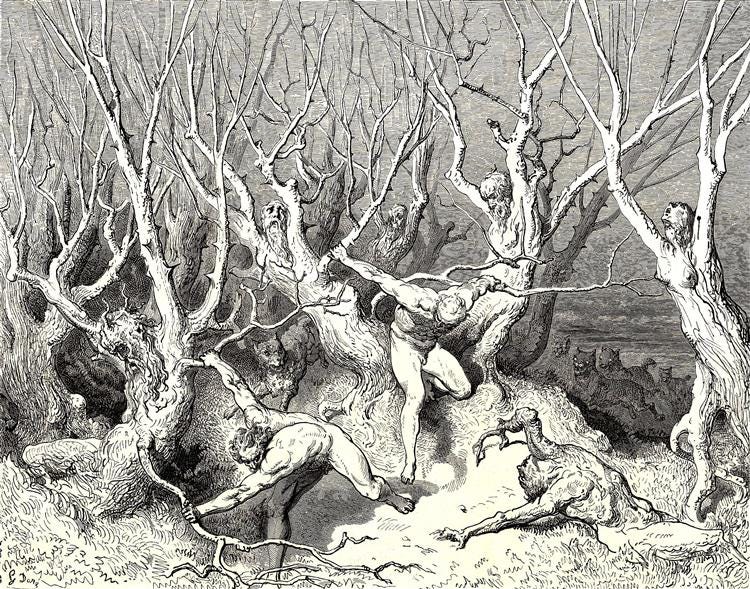
The first canticle of the Divine Comedy, Inferno, opens with the pilgrim Dante lost in a dark wood:
When I had journeyed half of our life’s way,
I found myself within a shadowed forest,
for I had lost the path that does not stray. 1
These famous lines are, of course, indicative of a deep spiritual crisis. However, their metaphorical meaning has become so familiar to us that it is difficult to notice the significance of the literal image, the forest in which Dante has taken a wrong turn. The central, often overlooked, theological motif of the Commedia is the tree. Dante’s Catholic imagination transfigures the Edenic trees of Genesis and St. Paul’s interpretation of the cross of Christ into a pattern for all existence, culminating in his vision of what C.S. Lewis, in "Imagery in Dante's Comedy,” refers to as the “time tree” of Paradiso, in which the poet is granted insight into the roots of being in the Unmoved Mover.
Canto I of Inferno begins with a distinctly Latinate Italian word for forest—selva. This word is used twice within the first two stanzas, first as a selva oscura, or “dark wood,” then as selva selvaggia, or “savage wood”. This word distinguishes the forest from its more truculent Germanic equivalent that was adopted into Latin: bosco, which is used to describe the forest of suicides. In general, forests are a locus of confusion for Dante, a place of sleep and futility. The forest of Canto I is the forest of the fallen world, distinctly treacherous and unwelcoming. Virgil, in his pagan, unconscious despair does not seem entirely out of place in it when he appears; for while it carries with it a classical grandeur that has not entirely lost a connection with the divine, it broadly symbolizes diminishing hope and correspondingly increasing despair. This point is furthered by the famous words upon the entrance to hell that the two poets encounter within the forest. Even earlier, in describing his efforts to scale the mountain blocked by the wolf, Dante announced his loss of hope: “ch’io perdei la speranza” (Inferno 1, 54). Dante’s spiritual disorientation runs deep, and the woods serve to link Dante’s condition to the forest of suicides while granting a last lingering light of possibility that distinguishes them from the latter. This link implies that his despair has reached a crisis point, and it is only Virgil’s intervention, at the injunction of his departed muse, Beatrice, that allows him to begin a process of metanoia2 that will begin to redeem him from his fallen condition.
Virgil’s offer to lead Dante through hell is informed by his description of Aeneas’s descent into the underworld in his epic poem, Aeneid. Aeneas must descend to seek the counsel of his father, Anchises, whose gift to Aeneas is intellectual understanding of the structure of the cosmos. Aeneas is given a vision of the whole that is rational and political. Dante’s choice of Virgil as a guide through the Inferno is fitting, given that he can bring Dante to the foot of spiritual salvation, to the other side of the globe from those who have “lost the good of intellect,” but he cannot pass beyond, into the cleansing spiritual repentance of the mountain reserved for Christians. In Virgil’s account of Aeneas’s descent, he is instructed to bring a sprig of the foliage known as the Golden Bough in order to be able to return to the living, which is the greatest challenge of making a decent into the Underworld, according to the Sybil of Cumae. Dante does not mention the bough, yet he does mention Aeneas by name when he expresses his unworthiness for such a journey as Virgil commends, stating “I am no Aeneas, I am not Paul.” He explicitly anticipates a descent such as that of Book VI of Aeneid, but the Golden Bough is nowhere to be found. The bough, sacred to the “Infernal Queen” Persephone, has perhaps, for Dante, been superseded by the cross. This claim will become more evident when we turn to the pageant in the earthly paradise at the top of Mount Purgatory.
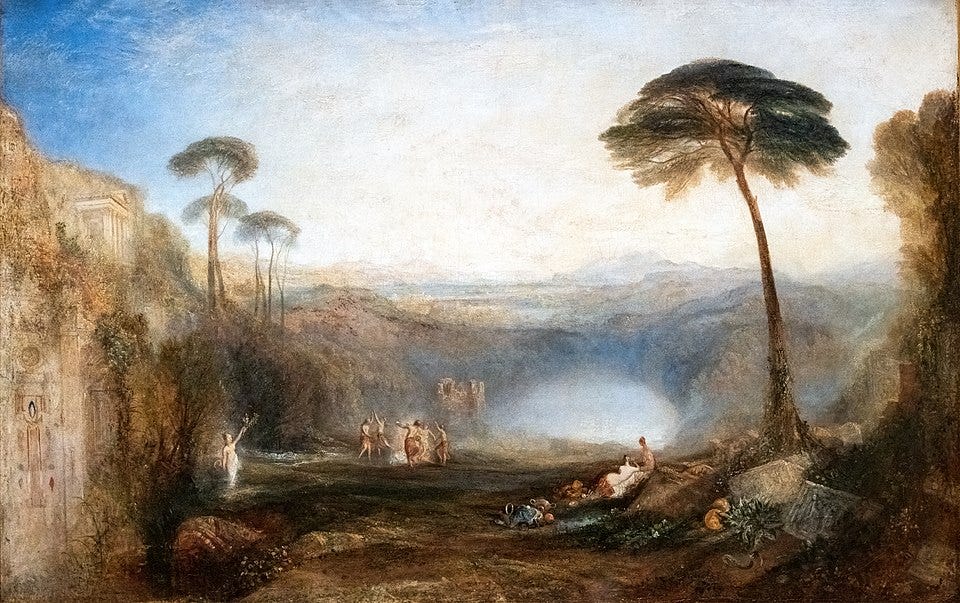
Directly striking a classical note, in Canto III Dante offers a simile in the vein of Homer and Virgil as he gazes upon the eternal ferryman, Charon, and at the souls destined for hell.
As, in the autumn, leaves detach themselves,
first one and then the other, till the bough
sees all its fallen garments on the ground,
similarly, the evil seed of Adam
descended from the shoreline one by one,
when signaled, as a falcon—called—will come. (Inf. I.112-117)
This autumnal tree is Adam, and its leaves are humanity. Dante seems to be implying that by eating of the tree of the knowledge of good and evil and willfully choosing a temporarily forbidden path, Adam linked himself with the tree, becoming the source of fallen human nature, in which all of his descendants share. The vision is a pagan, classical one, but filtered through a Christian text that reinterprets naturalistic, proto-Stoic resignation to decay, in terms of a post-Edenic fallen existence that stems from a single common ancestor. The simile parallels one in the Aeneid:
Here a whole crowd came streaming to the to the banks, […]
as many souls as leaves that yield their hold on boughs and fall
through forests in the early frost of autumn,
or as migrating birds from the open sea
that darken heaven when the cold season comes
and drives them overseas to sunlit lands.3
Virgil’s leaves are brought down by the first frost of autumn, the souls filled with longing to be first to enter the far shore. Dante’s souls are called, one by one, presumably by name, and have a sense of dignity that does not exist among those recorded by Virgil. While Virgil’s deaths are merely a natural process, one driven by the changing seasons of existence and the winds of desire, Dante’s are personal, with Charon calling each soul in turn. Dante baptizes Virgil’s silvan simile by taking a natural, Homeric-style literary image and linking it with Adam, a man whose fate was inextricably linked with a tree, who yoked his descendants to this upright plant in a more than metaphorical way. This link will be explored more fully in parts II and III.
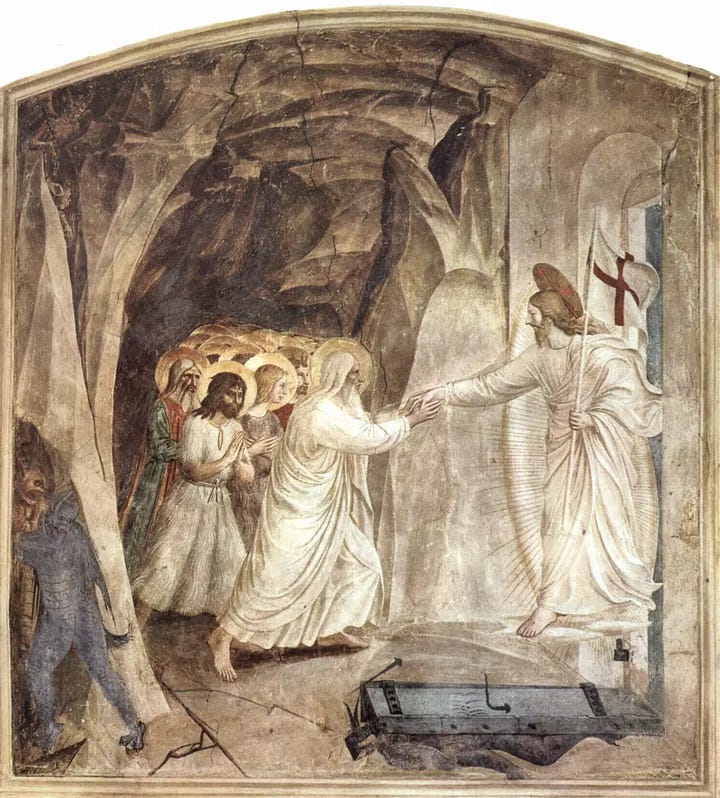
After Dante encounters Virgil and descends into the pit, we see the next mention of a forest. Here, on that “deep and savage road,” Virgil explains to Dante that he is now in Limbo, a place devoid of allegiances but visited by Christ himself during the Crucifixion:
I was new—entered on this state
when I beheld a Great Lord enter here;
the crown he wore, a sign of victory.
He carried off the shade of our first father, […]
and many others—and He made them blessed;
and I should have you know that, before them,
there were no human souls that had been saved. (Inf. IV.52-63)
This is the harrowing of hell, and here Adam is mentioned again, this time not by name, and in conjunction with another whose name is never directly mentioned in the Inferno, and only rarely after. Immediately following this allusion to Christ, Dante says, “we still continued onward through the wood— / the wood, I say, where many spirits thronged.” Here, in Limbo, the souls who are lost dwell in a forest, left behind in the harrowing of Hell. Some of Augustine’s darkest theological claims are illustrated here by the cries of the unbaptized infants that reach the pilgrim’s ears. The more mature souls here have the worst of all fates, loving neither the wrong things nor the right ones. They are truly lost in a dark wood.
Dante continues his sojourn through Limbo, that sightless realm, and he and Virgil are joined by a host of ancient poets, four in all, who accompany them through the city gates rising before them. Within the city of seven gates, there is light, and Dante and his company climb a hill as they near the gates in order to gain a better perspective on the gathering of souls on this well-lit meadow. Dante has been joined by the host of poets, and in order to better gain perspective on the philosophers present below they climb to heights surpassing those of the thinkers. Certainly Dante concedes to the command of the philosophers, but does not admit their ultimate authority. The poets, who have apparently been allotted the realm just beyond the city gates (reminiscent of the Republic) but nonetheless have passage inside, ultimately have the higher vantage, one closer to God than even that of “the Master of those who know,” Dante’s term for the Greek philosopher Aristotle. The other significant element of this scene is the fact that Dante has left the metaphorical woods, albeit for a short time, by climbing the treeless hill into the light. Surely, the light of the mind is one way to rise above the confusion of the forest of passions, yet Dante insists on the preeminence of poetry over philosophy within the realm of the mind, and on the circumscribed reach of both when unaided by the theological virtues.
The mood of this scene is unmistakably Edenic, and strikingly similar to that of the Elysian fields encountered near dusk in Purgatory— another treeless expanse. It is a sort of pagan garden of Eden, but an Eden with a conspicuously absent set of trees. One is forced to remember, despite these paradisiacal echoes, that these poets are in the first circle of Hell, and like all souls in Inferno have, astonishingly, “lost the good of intellect” (Mandelbaum 68)— a bold claim to make about Socrates, Euclid and Plato. For Dante, there is something incomplete about these meadows, and therefore about philosophy as a way of life. For Dante, the woods of the fallen world still threaten to close in on this admirable company, and they must content themselves with seeing by firelight, on the outskirts of the cave that is the Inferno.
As Dante descends into the windy second circle, the circle of lust, he requires divine assistance to enter the city of Dis itself, the approach of which sounds like a wind that shatters the branches of a forest.
And now, across the turbid waves, there passed
a reboantic fracas—horrid sound,
enough to make both of the shorelines quake:a sound not other than a wind’s when, wild
because it must contend with warmer currents,
it strikes against the forest without let,shattering, beating down, bearing off branches,
as it moves proudly, clouds of dust before it,
and puts to flight both animals and shepherds. (Inf. IX.64-72)
Once again, a force allied with heaven is portrayed as being at odds to the forest, a strange contrast, but a significant one. It seems likely that Dante expects the unknown angel’s arrival to remind us again of the harrowing of hell, the central underworld event announced in the Paschal hymns of the Orthodox liturgy: “...and upon those in the tombs bestowing life.” In this windy land, consumed by lust, enters a being whose love is like a hurricane, far more powerful than the gusty, aimless love of Francesca and Paulo and the impulses of their tormentors. The path to resurrection is not a tame one. As Jesus of the Gospel of Luke proclaims, “I have come to bring fire on the earth, and how I wish it were already blazing!” Dante highlights this destructive side to the divine love, while his simile reminds the reader yet again of the pathless wood from which Dante seeks to escape.
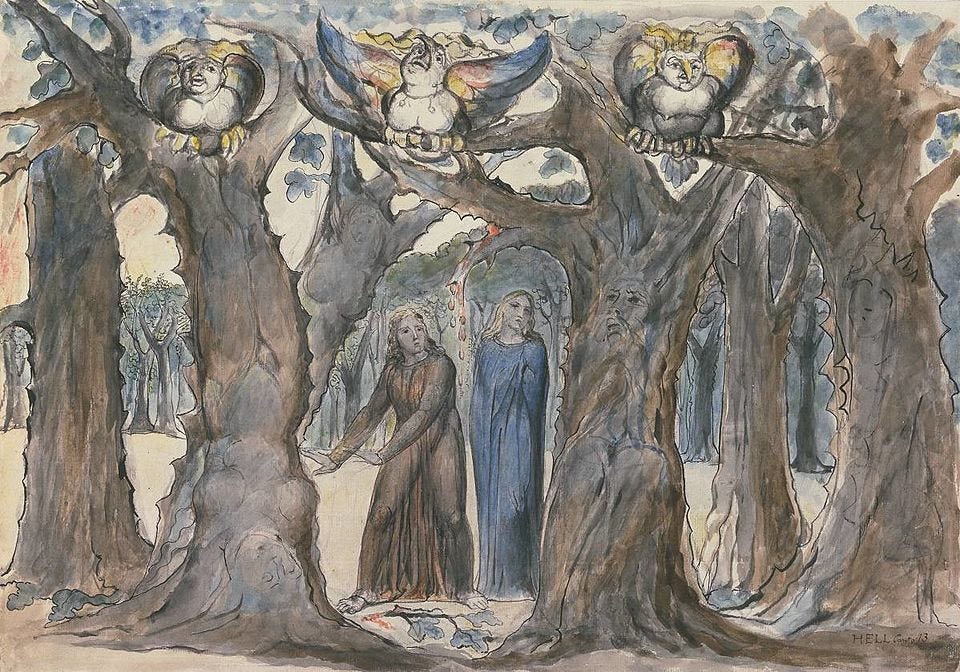
As mentioned before, there are two parts to Dante’s use of the image of the tree and the forest, one of which is rooted in the Inferno; the other bears fruit only in the Purgatorio. Here, the two branches diverge. The dark heart of the first is in canto XIII in the Seventh circle, perhaps the most chilling and moving part of the Inferno, with the exception of the tale of Ugolino in XXXIII. Dante writes,
…we began to make our way across
a wood on which no path had left its mark.No green leaves in that forest, only black;
no branches straight and smooth, but knotted, gnarled;
no fruits were there, but briers bearing poison. (Inf. XIII.2-6)
The woods are filled with harpies cawing lamentations in the eerie trees. The harpies are immediately reminiscent of a Roman underworld, and in fact, the entire canto is strikingly rooted in Virgilian imagery. However, the woods are also distinctly more “savage” than those of Canto I, and accordingly Dante avoids selva, with its classical undertones and substitutes in the word bosco, an Italian word with a Germanic root, imported into Latin from the wilds of Gaul.4 The trees are gnarled and bent, presumably in part from growing below the earth, where, like ingrown hairs, they have come to resemble roots. There are are indistinct voices hanging in the stultifying air.
Dante, with Virgil’s guidance, discovers that the voices he hears are in fact coming from the trees themselves, and reaching out breaks off a branch, resulting in the moan “Why do you tear me? / And then, when it had grown more dark with blood, / it asked again: “Why do you break me off? /Are you without all sentiment of pity? / We once were men and now are arid stumps: /your hand might well have shown us greater mercy/ had we been nothing more than souls of serpents” (Mandelbaum 112). In Virgil’s epic, it is by breaking off a bough of a tree, golden, not earth-hued, as in Dante, that Aeneas gains entry into the underworld. These trees give access to the their inner life through the breaks. Here there is also an allusion to the serpent in the tree in Eden, whose nature the people entrapped in the trees claim they resemble. The trees hate to have their branches torn, yet can only speak coherently through such a wound. One is also reminded of the central mystery of the Christian faith, Jesus’s claim that his body was broken for us, for the forgiveness of sins. The logos speaks in suffering, and the stumps of wood are momentarily returned to their characteristic human nature of speech. Dante describes the dual stream of blood and speech as being like a sapling log that catches fire along one of its ends, drips and hisses with escaping vapor at the other. Blood, speech, and trees are woven together in a sickly inversion of the mass, a sacrifice to the self.
Through this encounter, we are reminded once more of the woods Dante wandered through before encountering Virgil, and of his crisis of the soul. It is revealed to Dante through a conversation with the tree who turns out to be the soul of an advisor to the Frederick II, that this is the forest of suicides, and that this man’s mind, “believing it could flee disdain through death, made me unjust against my own just self.” The reflexive here reveals the problem at the heart of suicide—death is not merely an attack on the body, it tears unjustly at the very self, the unity of soul and body emphatically insisted upon by orthodox Catholic theology.
Dante wishes to know how the soul is bound into such woody knots and what future they can expect. The spirit responds by describing a kind of pagan parable of the sower, in which Minos tosses souls like grains of spelt, left to sprout where they will in this mournful place. Furthermore,
Like other souls, we shall seek out the flesh
that we have left, but none of us shall wear it;
it is not right for any man to havewhat he himself has cast aside. We’ll drag
our bodies here; they’ll hang in this sad wood,
each on the stump of its vindictive shade.” (Inf. XIII.103-108)
This response is frightening in its clarity about what will befall them in the days to come, but the reason for it is still obscure, and must be more deeply explored, since many questions are raised. This passage is, I believe, the key to understanding one side of Dante’s use of the tree in the Commedia. In the text above one finds a powerful double image. At the Judgement, Dante is saying, those who inhabit the wood of suicides will be forced to drag their own bodies, like Jesus dragged the cross, but in their case their bodies shall hang upon their souls, souls which have become as wood, mere stumps, left after the wood for the cross was cut. For indeed, Dante sees the souls as having committed the crime of abandoning their providential assignment in life, which might have appeared as random as the sowing of grains of spelt but was imbued with pattern. They are now are cursed to be merely roots and trunks, unable to be moved by love. While Jesus died upon a tree to save all, they died only to save themselves. Dante places great importance on playing one’s role on the stage of the world, and to die to escape it is most ill-conceived. In life, according to Dante, the body is the cross we must bear, and to destroy it is to ruin what has been “created in the image of God.” Jesus called sinners to take up their cross and follow him, but these instead ran away, seeking to save their life by losing it, but not for His sake, or for others. As the Gospel of John states, there is nothing sweeter than to lay down one’s life for one’s friends, but here, those in the forest of suicides have cemented themselves even further in their love for their own, fallen self. They have taken something that is by nature full of good, and turned it into a place of death. The unnamed shade at the end of the canto proclaims, speaking for the fate of many in this circle, “I made—of my own house—my gallows place.” The man has turned his dwelling place (of wood!) into Golgotha, but no redemption is found here; instead there is the inward, self-destructive turn of those who have chosen to destroy what they mistakenly believe to be their own in order to preserve what has never truly been theirs to keep: their reputation and an escape from suffering.
Incidentally, there are four obvious personages whose souls ostensibly belong in this circle, but who are missing due to their greater virtues or vices. Judas infamously died by his own hand, and Dante reserves one of the three maws of the silent, weeping Satan for the portrayal of his torments. Judas hangs beside Brutus and Cassius, two other suicides, whose betrayal of Caesar similarly drags them into the deep. On the other hand, Cato the Younger also died by suicide, and lived before Christ. Astonishingly, Dante reserves the gatekeeping of Purgatory for this noble Stoic, leaving the reader to wonder at the poet’s vision of divine mercy.
Dante seems to hint through all of this that he might have found himself among this company, had Virgil not appeared to him. For not long ago he too, was lost in a dark wood, which, like the earth-colored forest here, was “unmarked by any path.” Amongst the self-murders there are also hounds that attack those in the woods, and Dante’s self-reflexive statement, “I found myself” is echoed here by the final lines of the chapter in the description of the hanging. Dante frequently sees some element of the sin he encounters reflected in his own life, but here the identification seems particularly pronounced. Dante’s descent from this point on, produces, paradoxically, an increased will to live, culminating in his first glimpse of the stars after he passes the center of the earth and emerges into the pre-dawn splendor of the southern skies beneath Mount Purgatory. Virgil proclaims at the end of Canto XIV that the time has come for Dante to leave the forest of self-destruction behind. He will not traverse any more groves until he enters the earthly garden at the end of the second canticle, Purgatorio.
You can find Part II here:

All translations are from Allen Mandelbaum’s version. Dante Alighieri, and Allen Mandelbaum. The Divine Comedy. A.A. Knopf, 1995. Page 59.
Despite the Greek origin of the term, I find it to be more indicative of Dante’s renewal than the Latin paenitentia which translates as “repentance.”Metanoia might be translated “the turning around of the soul,” or “a reordering of the intellect.”
Virgil, and Robert Fitzgerald, The Aeneid, Random House, 1983, page 170.
Interestingly, this word has a cognate in the Spanish bosque and survives in English as an archaic adjective, “busky,” meaning wooded. Busky is used by Shakespeare in Henry IV to describe a distant forested hillside before a battle.
Beautiful and thoughtful. Beautifully written. But the word you refer to in the opening lines of Inferno is “selva” not “silva” (which is not an Italian word).
Brilliant exegesis on Canto XIII. The idea that suicides turned themselves into what shoudve been their salvation (the cross as tree) is kinda haunting. I remember reading Inferno in college and totally missing that inverted sacramental logic. The connection between breaking branches to reveal speech and Christ's broken body giving us the Word feels almost too perfect yet somehow Dante pulls it off without beign preachy.